
 Available in US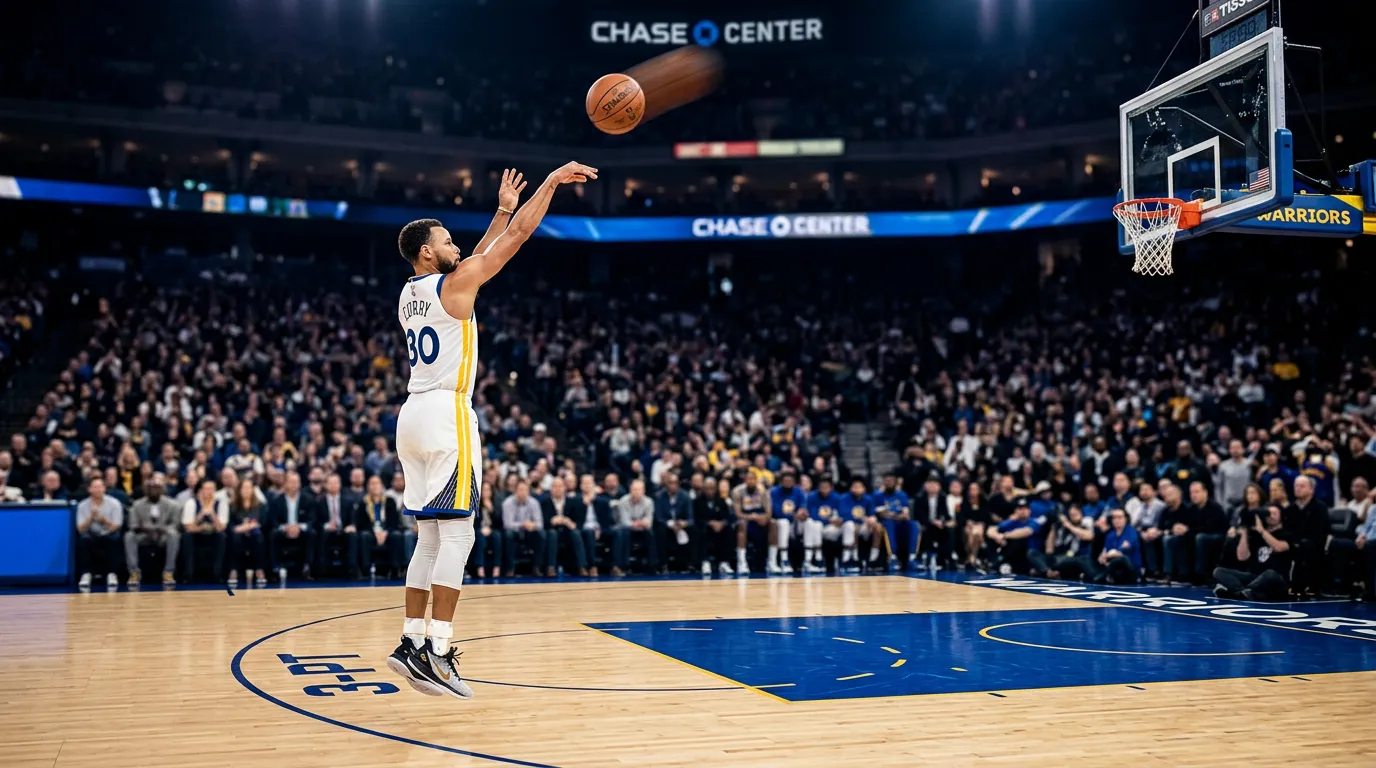
Stephen Curry’s three-pointer props taught me the most expensive lesson in shooting variance. I backed his over 4.5 made threes at -130 for what felt like guaranteed money – he’d hit that number in 12 straight games. He went 2-for-11 from deep. The line was priced assuming exactly the sequence that had just occurred; the value I thought existed was already baked into the odds. Three-point betting requires respecting variance in ways that other props don’t.
Made three-pointer props ask how many long-range shots a player will convert in a given game. Lines typically range from 1.5 for role players to 4.5 or higher for elite shooters. The market’s appeal lies in its focus on a single, measurable skill with clear outcome – either the ball goes through from beyond the arc or it doesn’t.
The challenge: three-point shooting carries enormous game-to-game variance even for consistent shooters. A player shooting 40% from three averages 4 makes on 10 attempts, but individual games might see 1 make or 7. That distribution makes prop betting on threes inherently volatile, requiring careful analysis beyond simple averages.
Analysing Three-Point Shooting Props
Attempt volume matters more than shooting percentage for prop betting. A player attempting 8 threes per game at 35% has more over potential than one attempting 5 at 40%. The extra attempts create more opportunities despite lower efficiency. Track attempts not just makes when evaluating three-point props.
Shot selection patterns affect variance differently. A catch-and-shoot specialist receiving clean looks from consistent positions shows more predictable results than a player creating his own shots off the dribble. The latter’s output fluctuates more dramatically based on defensive coverage and shot difficulty each night.
Recent form indicators deserve appropriate weight – neither ignored nor overvalued. A shooter in a cold streak might be due for regression; he also might be dealing with minor injury affecting his stroke. A hot shooter might continue patterns or regress toward career norms. Consider whether recent performance reflects skill-level changes or random variance.
Minutes expectations directly scale three-point opportunity. A player projected for 35 minutes has more chances than one expecting 28. Monitor injury reports affecting rotation depth – a teammate’s absence might increase your target’s minutes and thus attempts. Game script projections matter too: blowouts reduce starter minutes regardless of individual performance.
Matchup Factors for Three-Point Props
Defensive three-point percentage allowed varies significantly between teams. Some defences allow high volumes of perimeter attempts but contest well, keeping percentage low. Others surrender fewer attempts but allow higher conversion on the shots they do give up. Match your target’s style against the specific defensive profile they’ll face.
Individual defender assignments create micro-matchups within team statistics. A slow-footed big man switched onto a perimeter shooter creates easier looks than a defensive specialist. Review how opponent defences handle specific player types rather than relying solely on team-level statistics.
Pace expectations affect attempt volume. Faster games generate more possessions, more shot attempts, more three-point opportunities. A player averaging 3.5 made threes in a typical game might have over potential in projected high-pace matchups and under potential in grind-it-out defensive battles.
Home versus away shooting splits persist for many players. Familiar shooting backgrounds, consistent rims, and crowd energy contribute to home court advantage in three-point percentage. Check whether your target shows meaningful home/away differential before assuming road performance matches home output.
Team Three-Point Totals Strategy
Team made threes props aggregate all players’ attempts into single market. Lines typically sit between 10 and 16 made threes depending on team style. This market reduces individual variance by spreading exposure across multiple shooters – one player’s cold night can be offset by another’s hot performance.
Team offensive philosophy drives three-point attempt rates. Some teams prioritise perimeter shooting, attempting 40+ threes per game; others focus inside, attempting 25-30. These tendencies are stable and predictable, making team totals more projectable than individual player outcomes.
Opponent defensive philosophy mirrors offensive consideration. Teams allowing many three-point attempts create over opportunities; those suppressing perimeter shots favour unders. Cross-reference your team’s shooting tendencies with opponent’s defensive allowances for game-specific projections.
Game script expectations affect team three-point volume. Trailing teams typically increase three-point attempt rate seeking to close deficits quickly. Leading teams might reduce attempts while running clock. Anticipated close games produce more representative outputs; expected blowouts in either direction distort normal patterns.
Three-Pointer Betting Questions
Building Your Three-Point Prop Approach
I favour team three-point totals over individual props because the variance reduction makes outcomes more predictable. Individual shooter props require being right about that specific player’s performance; team totals allow for substitution effects where multiple players can contribute to hitting the number.
When I do bet individual three-point props, I focus on high-volume shooters in pace-favourable matchups against defences that allow perimeter attempts. This stacking of positive factors doesn’t guarantee success but creates conditions where overs have structural support beyond hoping for outlier performances.
The under side deserves consideration when factors align negatively. A high-volume shooter facing elite perimeter defence in a slow-paced game might struggle to reach even modest lines. Most bettors default to overs on exciting shooters; contrarian under positions can offer value at inflated prices.
Track your three-point betting separately from other props. The variance profile differs enough that results from these markets might diverge significantly from your other prop betting performance. Identifying whether three-point props are profitable specifically helps allocate bankroll appropriately to this volatile market segment.
Consider correlation effects when building same-game parlays involving three-point props. A team hitting many threes typically leads to higher scoring, creating positive correlation between made threes overs and game totals overs. Conversely, a player hitting threes correlates with his team’s success, making three-point props interdependent with spread outcomes in ways that affect parlay construction.
The three-point revolution in modern NBA creates more betting opportunities than existed historically. When teams attempted 15 threes per game, the market was niche; now with teams attempting 35+, three-point props have become mainstream betting options with deeper liquidity and more sophisticated pricing. This maturation means edge is harder to find but opportunities exist for bettors who analyse more thoroughly than lines reflect.
Shooting variance will frustrate you regularly regardless of analytical quality. Accept this volatility as inherent to three-point betting rather than evidence of flawed analysis. Even correct assessments produce losses frequently – the math works across large samples, not individual games. Patience and consistent methodology matter more than any single result.
The long-term edge in three-point betting comes from superior volume and matchup analysis applied consistently over hundreds of games. No single bet defines success; the process determines profitability over seasons of NBA action.
Articles
Prepared by the nbabetonline editorial staff.
